A Comprehensive Guide to Investment Plans: Balancing Returns and Risk
Date: 07 July 2024

Introduction
Navigating the complex landscape of investment options can be daunting for both new and seasoned investors. With an array of choices ranging from low-risk savings schemes to high-return equities, understanding the nuances of each option is crucial to making informed decisions. This blog aims to demystify various investment plans, shedding light on their expected annual returns and associated risk levels. By providing a clear overview, we hope to
equip you with the knowledge needed to tailor your investment strategy to your financial goals and risk tolerance.
Investment Plans Overview
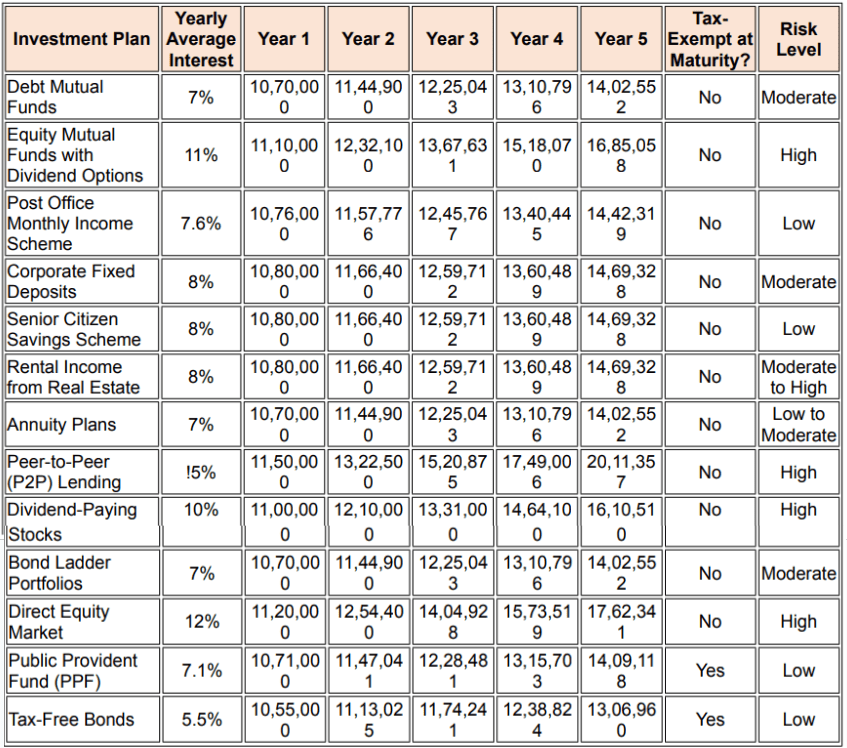
Investing is a key strategy for growing wealth and achieving financial stability. The following investment plans each offer unique advantages, balancing potential returns with corresponding risk levels:
The following illustrations offer a clear understanding of how an investment of 10 lakhs can grow over time, considering tax exemptions and different risk levels. Please note that these examples are for illustrative purposes only and not intended as investment recommendations. For personalized advice, please consult with a professional investment advisor.
Notes on tax-exempt options:
Tax-Free Bonds:
- These are usually issued by government entities.
- The interest earned is completely tax-free.
- They typically have a long lock-in period (10-20 years) and lower returns compared to taxable options.
Public Provident Fund (PPF):
- The interest earned and the amount withdrawn at maturity are tax-free.
- It has a lock-in period of 15 years, but partial withdrawals are allowed after 5 years.
- The rate is subject to change quarterly by the government.
Remember:
Tax laws can change, so always verify the current tax status of investments. The PPF has an annual investment limit (currently Rs. 1.5 lakh per year). Tax-free bonds are not always available for purchase and may only be offered during specific periods.
These tax-exempt options generally offer lower returns but provide the benefit of tax-free income, which can be advantageous depending on your tax bracket and overall financial strategy.
Conclusion
Selecting the right investment plan is a pivotal step in securing your financial future. Each investment option comes with its own set of risks and rewards, making it essential to align your choices with your financial objectives and risk appetite. Diversification remains a key strategy to balance potential returns and manage risks effectively. Whether you prefer the stability of debt
mutual funds and government schemes or the high returns of equities and P2Plending, understanding these options empowers you to make informed decisions. Invest wisely to build a robust portfolio that supports your long-term financial aspirations.
By comprehensively evaluating your investment choices, you can create a strategy that not only meets your current financial needs but also paves the way for future growth and security. Happy investing!


Leave a Reply