Bullish & Bearish Harami Candlestick Patterns
Date: 02-Nov-2026
The Harami candlestick pattern is a two-candle reversal pattern used in technical analysis. It indicates a possible change in market direction.
The word Harami means “pregnant” in Japanese because the second candle’s body is contained within the first candle’s body.
There are two types:
- Bullish Harami – Potential reversal from downtrend to uptrend.
- Bearish Harami – Potential reversal from uptrend to downtrend.
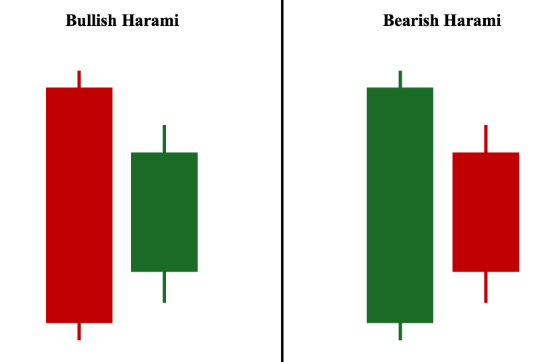
| Bullish Harami | Bearish Harami |
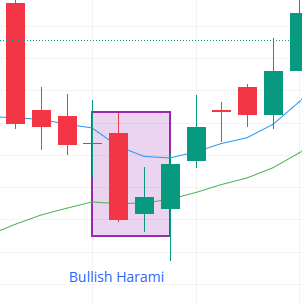 | 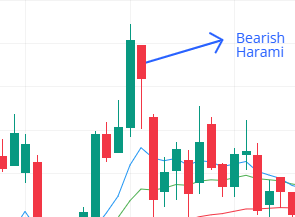 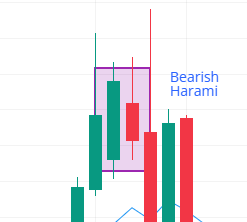 |
| Bullish Harami should be formed after at least 5 candle or 15% down in downtrend | Bearish Harami should be formed after 5 candle at least or 15% up in uptrend |
| First candlestick should be red | First candlestick should be green |
| Second candlestick should be green | Second candlestick should be red |
| Second candlestick should be gap-up open | Second candle should be gap-down open |
| The second candle’s (green) real body must be completely inside the first candle’s (red) real body. | The second candle’s (red) real body must be completely inside the first candle’s (green) real body. |
| Second candle can be any candle-doji, hammer, inverted hammer etc. | Second candle can be any candle-doji, Shooting Star, Hanging man etc. |
| Wicks of candle doesn’t matter while checking Bullish Harami pattern | Wicks of candle doesn’t matter while checking Bearish Harami pattern |
| Buy on next candlestick- or lower based on risk management | Sell on next candlestick- or upper based on risk management |
| Stop loss should be on lower wick of these two candlestick | Stop loss should be on upper wick of these two candlestick |
| Set stop loss after closing of next candle | Set stop loss after closing of next candle |
Disclaimer: The information provided here is for educational and informational purposes only and should not be construed as financial, investment, or legal advice. Always do your own research and consult with a SEBI-registered financial advisor before making any investment decisions. Investments in the financial markets are subject to risks, including the risk of loss of principal.


Leave a Reply